
The Mud Bath
DESIGN BY EALAIN-JAQ STUDIO
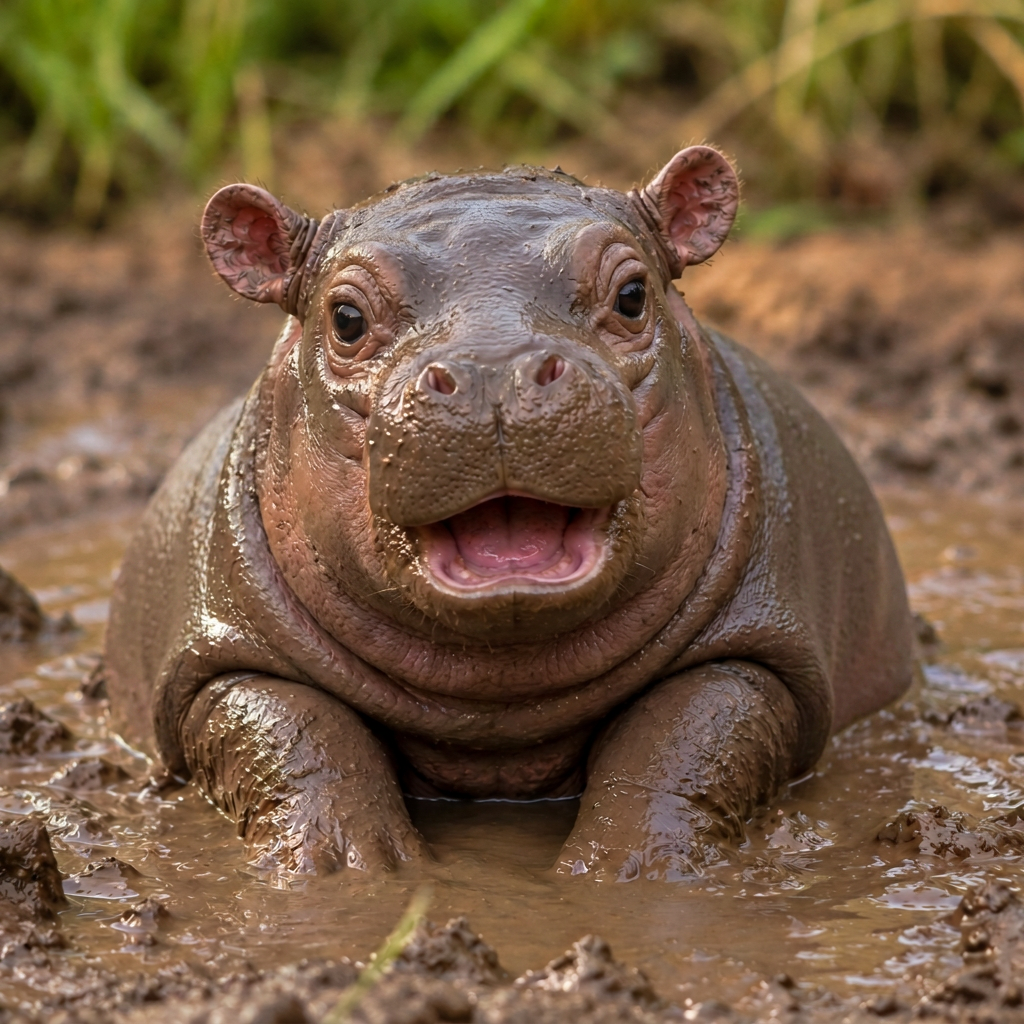
FIG 1. ORIGINAL ARTWORK
EJ000771D
#photoLocation

PRODUCT DESCRIPTION
The Mud Bath captures a young Common Hippopotamus settled contentedly into a shallow wallow, its rounded body coated almost completely in a gleaming layer of wet brown mud. Facing directly towards the viewer, the calf holds its head high above the muddy surface with its mouth open, creating an unusually animated and engaging portrait.
Thick mud follows every contour of the animal's broad muzzle, cheeks, forehead and shoulders, collecting in fine irregular traces across the textured skin. Small rounded ears project from either side of the head, their pink interiors contrasting with the earthy coating, while wide dark eyes catch the surrounding light. Around the eyes, muzzle and folds of the neck, warmer pink-brown skin remains visible beneath the moisture.
The calf's sturdy forelegs extend forward into the wallow, disappearing gradually beneath the opaque water and churned mud. Small ridges and clumps surround the body, recording the disturbance created as the animal settled into the soft ground.
Behind the calf, the muddy bank rises into a softly blurred fringe of green vegetation. Natural diffused light reflects from the wet skin and shallow water, emphasising the contrast between the heavy earthiness of the wallow and the remarkably expressive young animal at its centre.
ABOUT THIS COLLECTION
#aboutThisCollection
BACKGROUND AND HISTORY
The Common Hippopotamus (Hippopotamus amphibius).
For a hippopotamus, covering itself in mud is far more than an opportunity to make a mess. A wallow can provide an important refuge when deeper water is unavailable, particularly as pools shrink during dry conditions.
Hippos are highly vulnerable to overheating and dehydration when exposed for long periods on land. Their skin contains relatively few conventional sweat glands, and they depend heavily upon water, shade and damp environments to remain cool. Wet mud coating the body can help retain moisture for a time after an animal leaves a wallow, while the wallow itself provides relief from direct solar exposure and high daytime temperatures.
Mud can also form a physical layer over the skin, although it should not be thought of as the hippo's only “sunscreen.” The animal produces its own unusual skin secretions containing pigments known as hipposudoric and norhipposudoric acids. These contribute antimicrobial activity and absorb ultraviolet light, complementing behavioural strategies such as remaining submerged or resting in shade.
Wallowing can become particularly important during seasonal droughts. As rivers and pools contract, many hippos may be forced into increasingly restricted areas of remaining water and mud. What appears to be a luxurious mud bath can therefore become a limited and fiercely important resource.
For this young calf, mud, water and shade are not simply places to play. They form part of the natural protection required by one of the world's most unusual mammalian skins.
CULTURAL CONTEXT AND SYMBOLOGY
#cultural
artwrk type
size
finish option
PURCHASE AND COLLECT THIS ARTWORK AS
measurement
SELECT QUANTITY
1
$20.00 AUD
Incl GST
ALL PRINTS COME PACKAGED AND ROLLED READY FOR YOUR CHOSEN DISPLAY TYPE
CONSERVATION INFORMATION
This design donates to animal and conservation efforts
Common Hippopotamus (Hippopotamus amphibius)
The muddy margins of rivers and wetlands are not simply resting places for hippopotamuses; repeated wallowing, trampling and movement can physically reshape them. Hippos create well-used pathways between water and their nocturnal grazing grounds, while their enormous bodies disturb soft banks and sediments. Over time, this activity can widen river margins, deepen wallows, form gullies and even contribute to the development of small channels through which water moves across the surrounding landscape. These effects have led ecologists to describe the Common Hippopotamus as an important ecosystem engineer.
Their influence extends into the vegetation around those waterways. Repeated grazing can maintain short “grazing lawns” with plant communities different from less frequently grazed areas, while hippo trails and wallows create patches of disturbed habitat throughout the river margin. Research suggests these changes can influence vegetation structure and the way other herbivores use areas close to water. Protecting healthy hippo populations therefore preserves more than the animals themselves: it also retains a powerful natural process that has helped shape African riverine landscapes for thousands of years.
SEARCHABLE TAGS
At Ealain-Jaq Studio, we believe in being open about the creation process behind our unique art pieces. To bring you a diverse and stunning collection of diamond paintings and canvas prints, we source and create our artwork using a variety of methods.
Every design we offer has a story, and that story begins with a spark of creativity. We are passionate about bringing you art that inspires, and our creative process is a thoughtful blend of human talent and technological innovation.
We believe deeply in supporting the artistic community, and a core part of our collection comes from licensed artwork from gifted artists and photographers, ensuring they are compensated for their incredible work. We cherish these partnerships, which celebrate their unique vision and support their craft. Alongside these collaborations, you will find captivating real-world photography and original designs born from the creative minds of our own team.
At the intersection of art and technology lies a world of new creative possibilities. We ethically embrace using both traditional artistry and cutting-edge technology and are excited to be at the forefront of this evolution, using a dynamic and modern approach to design the unique art pieces in our collections. We see Artificial Intelligence (AI) as a powerful new paintbrush, a tool to spark novel ideas and concepts. We leverage AI as a powerful co-creator to generate foundational images and explore concepts that would otherwise be impossible. These AI-generated images often serve as the first step in a longer creative journey, with our human artists lovingly applying their expert eye to refine, edit, and enhance them to add that essential human touch.
The best results often come from synergy. It is this beautiful collaboration, between artists, technology, and our passionate team that allows us to create the diverse and high-quality art kits you love. Thank you for being part of our creative journey.
Our fine art and canvas prints are produced to order, allowing each piece to be carefully prepared and checked before leaving the studio. Production and dispatch times may vary depending on the print format, size and finishing requirements selected. Please refer to the individual product page for any specific production timeframes.
We use Australia Post for all domestic and international shipping, with delivery times varying according to destination, carrier demand and customs process where applicable. As we are based in Western Australia, delivery typically takes approximately 2–4 business days within Western Australia and 3–6 business days for interstate destinations within Australia following dispatch.
If you need assistance with a return or exchange, please get in touch with us and we will be happy to guide you through the available options.
For full information regarding production, delivery, returns and exchanges, please refer to our Shipping & Returns Policy.
Although we do our best to show true colours representations, please note however that product images are photographed under lighting conditions that may affect colour appearance on screen. Due to variations in lighting, screen settings, and monitor resolutions, actual drill and canvas colours may differ slightly from the images shown.